Showing posts with label IFI7176. Show all posts

Monday, December 22, 2014

Task 8: Reflection on project work

After all's said and done, my ethnographic study of a team prior to toolset migration is finished. It took me quite a few hours of work, many of those comprised of simply sitting quietly while writing furiously everything people were doing. Interpreting hours of scribbling proved challenging and the fact I knew what most of those people were doing made the notes a lot more biased than I'd hoped for an academic document, but in the end it's fine for its pragmatic application.
Shadowing alone didn't do the trick, which was an unexpected result. Since I had prior knowledge of how the team is structured and how it theoretically relates - I was even partially responsible for the training of some of the newer members of the team - I was able to build a good theoretical map of the relationships between sub-teams and the toolset, but shadowing revealed behavioral quirks, technical misconceptions, work vices and other work characteristics that needed clarification. Therefore, a couple of short interviews were executed to better understand what was actually going on.
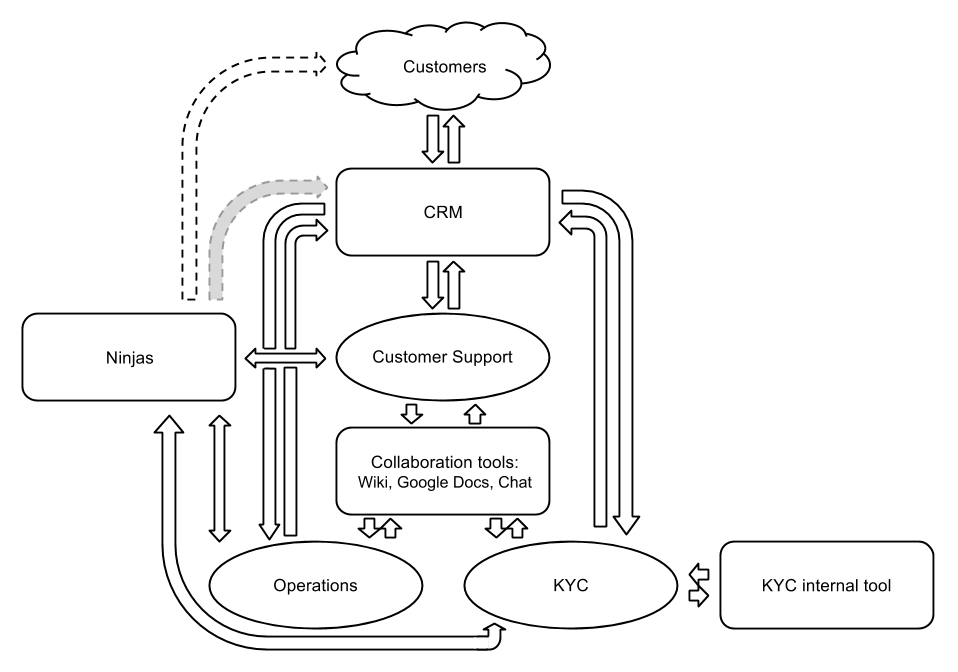
The result was a much more complex relationship map than previously anticipated. That was a sobering experience and I'll try to remember not to assume I understand how a team works only by superficial observation. This is the most important lesson I expect to carry into future field research projects. The good news is that I left the endeavor with a great understanding of how each sub-team uses the tool differently, how previous assumptions shaped current work vices and how to prevent these during the migration to the new tool.
It has also taught me an important lesson that I tried to convey in the final document - that while people are fixated on what functions tool A possesses and how to achieve the exact same function in tool B, the really important thing is that both tools allow for the same workflow, even if functions are not exactly analogous. Less focus on functions and a more holistic view of how work revolves around the tool will help us shape not only the migration effort, but also training for the new tool.

Sunday, November 9, 2014

Field research project outline - Ethnographic study of a team prior to toolset migration

The objective of this study is to understand Company A’s usage of their current Customer Relationship Management (CRM) tool to better prepare for the transition to a new web-based CRM tool. This study is necessary because Company A has put a lot of Engineering effort into integrating their current CRM tool into their own systems, as well as built years of workflow around the tools feature set

Of all departments in Company A, three departments have direct contact with the CRM tool - Customer Support (CS for short), with over 80 employees whose workflow is entirely centered around the tool and its integration into the Internal System (known internally as Ninjas), Operations, who have their own toolset (mostly developed in-house) but use the CRM tool to communicate with CS, who then act as a buffer between operations and customers themselves and Compliance, who, like Operations, have their own toolsets but make use of the CRM tool to communicate with CS and, sometimes, to customers themselves.

As the new CRM tool possesses all features of the current one (either a direct equivalent or an analogue feature that achieves the same results) and lots of new features, this ethnographic investigation’s short-term goal are:
  1. To understand how each team relates to the CRM tool
  2. To catalog all features used by each team
  3. To understand if the same workflows are approached differently by each team
To achieve this goal we intend to employ shadowing: the researcher will shadow one member of each concerned team during one hour of work. No information will be shared with the subjects on what the goals of the study are and they'll be asked to work normally and pay no regard to the researcher. The researcher will make notes during this time of every single action taken during the completion of their tasks, what tools are used and how information is conveyed between different tools.

The longer-term goals are to use this information to:
  1. Draft a migration plan that focuses Engineering resources on critical features first
  2. Ensure that the new CRM tool is configured to make workflow migration (as) seamless (as possible)
  3. Understand how to make better use of features not yet available in the current CRM tool to improve the current workflow once the new tool is available
  4. Draft training material for current and new team members on using the new tool